
🚗 The Ultimate Fluid Change Schedule 💧
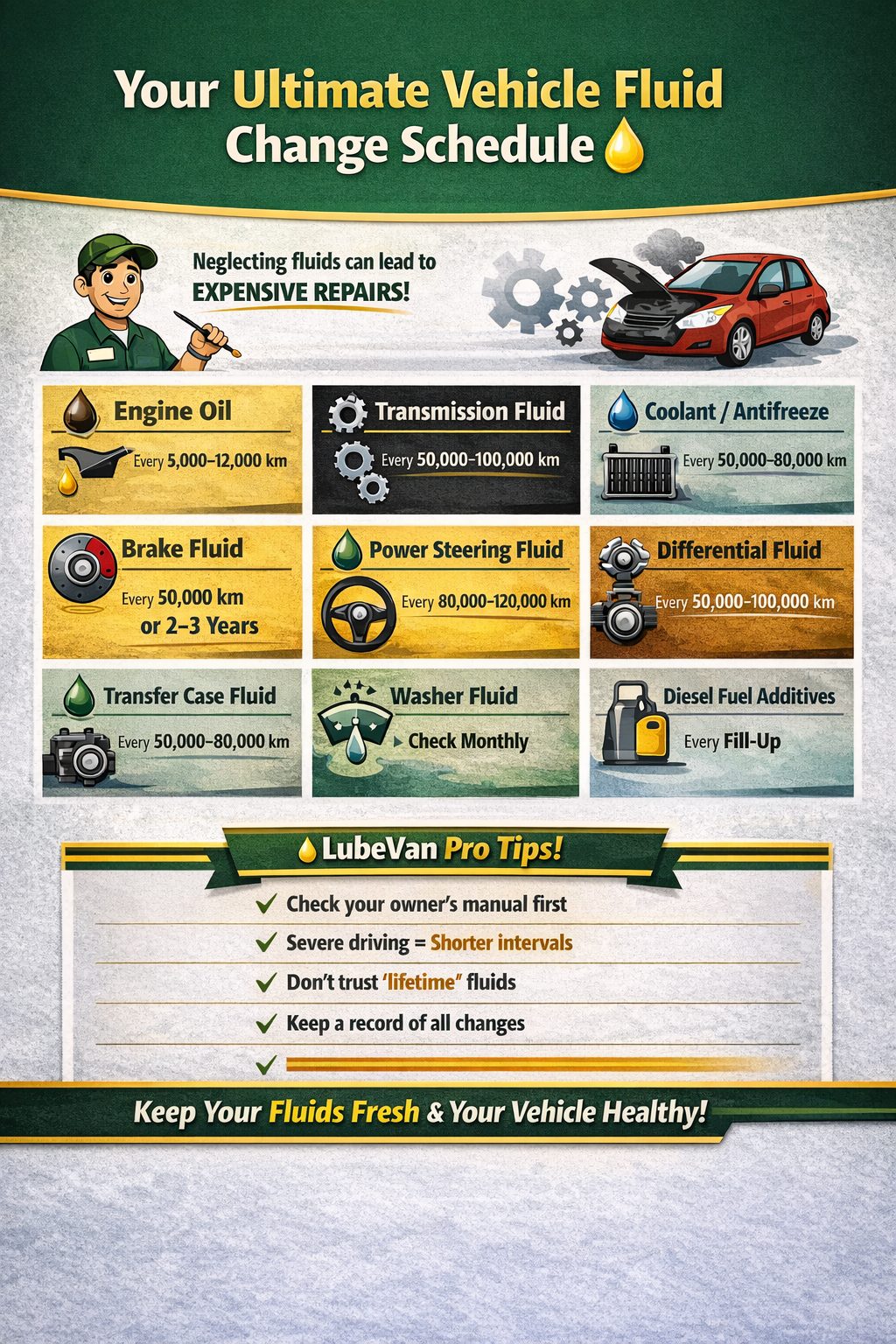
(Print This. Save It. Your Vehicle Will Thank You.)
Dear Vehicle Owner,
Pop quiz:
When was the last time you changed:
- Your transmission fluid?
- Your differential fluid?
- Your power steering fluid?
If you’re drawing a blank—you’re not alone.
Most drivers have no idea when their fluids should be serviced. Unfortunately, fluid neglect is one of the fastest and most expensive ways to destroy major vehicle components.
The good news?
Below is a clear, no-nonsense fluid change schedule designed for Canadian driving conditions. Keep this in your glove box and eliminate the guesswork.
1️⃣ Engine Oil (The Lifeblood of Your Engine)
Recommended Intervals
- Conventional Oil: Every 5,000 – 8,000 km
- Full Synthetic Oil: Every 8,000 – 12,000 km
- Diesel Engines:
- Best practice: Oil sampling to determine optimal intervals
- Conservative guideline: 6,000 – 8,000 km max with full synthetic oil
- Always follow manufacturer API specifications
Why It Matters
Dirty oil causes:
- Accelerated engine wear
- Sludge buildup
- Premature engine failure
Skipping oil changes doesn’t save money — It defers a very expensive bill.
2️⃣ Transmission Fluid (Automatic & Manual)
Recommended Intervals
- Automatic Transmission: Every 50,000 – 100,000 km
- Manual Transmission: Every 50,000 – 100,000 km
⚠️ Some manufacturers claim “lifetime fluid.” From a service perspective, there is no such thing.
Why It Matters
Old transmission fluid loses its ability to:
- Lubricate
- Cool
- Maintain hydraulic pressure
Result: slipping, harsh shifts, and eventual transmission failure.
3️⃣ Coolant / Antifreeze
Recommended Intervals
- Standard Coolant: Every 50,000 – 80,000 km or 3–5 years
- Long-Life Coolant: Every 160,000 – 240,000 km
(Still inspect regularly)
Why It Matters
Old coolant becomes acidic and:
- Corrodes radiators, heater cores, and engine internals
- Loses freeze and boil protection (critical in Canadian winters)
4️⃣ Brake Fluid
Recommended Interval
- Every 2 – 3 years or 50,000 km
Why It Matters
Brake fluid absorbs moisture over time, which:
- Lowers boiling point
- Causes internal corrosion
- Can lead to brake failure under heavy braking
Brake issues rarely give warnings—until it’s too late.
5️⃣ Power Steering Fluid
Recommended Interval
- Every 80,000 – 120,000 km or 3–5 years
Why It Matters
Contaminated fluid damages:
- Power steering pump
- Steering rack (high-cost repairs)
If steering feels stiff or noisy, your fluid is already overdue.
6️⃣ Differential Fluid
Recommended Intervals
- Rear-Wheel Drive: 50,000 – 100,000 km
- AWD / 4WD: 50,000 – 80,000 km
- Heavy towing / off-roading: 25,000 – 50,000 km
Why It Matters
Your differential handles extreme heat and load. Old fluid leads to:
- Gear wear
- Whining noises
- Complete differential failure
7️⃣ Transfer Case Fluid (AWD / 4WD Vehicles)
Recommended Interval
- Every 50,000 – 80,000 km
Why It Matters
Transfer cases fail catastrophically when fluid breaks down.
This is one of the most commonly forgotten—and most expensive—fluids.
8️⃣ Windshield Washer Fluid
Recommended
- Check monthly
- Use freeze-resistant washer fluid rated for Canadian winters
Why It Matters
You can’t drive safely if you can’t see—especially in snow, slush, or salt spray.
9️⃣ Fuel Additives (Diesel Engines)
Recommended
- Add diesel fuel treatment with every fill-up
Why It Matters
Modern diesel fuel:
- Lacks proper lubrication
- Contains water
Regular additives:
- Protect injectors
- Remove moisture
- Clean deposits
- Extend engine life by hundreds of thousands of kilometres
✅ Pro Tips from the Technicians
- Always check your owner’s manual first
- Severe driving conditions = shorter intervals, including:
- Frequent short trips (under 15 km)
- Extreme heat or cold
- Towing or hauling
- Stop-and-go city driving
- Dusty or dirty environments
- Don’t trust “lifetime” fluids
They’re designed around warranty periods — not long-term ownership. - Keep service records
Improves resale value and keeps maintenance predictable.
🔎 All fluid intervals depend on actual condition and usage. Regular inspections allow adjustments before damage occurs—not after.